
The Bark Keeps a Mark
Place a small cut in the original trunk
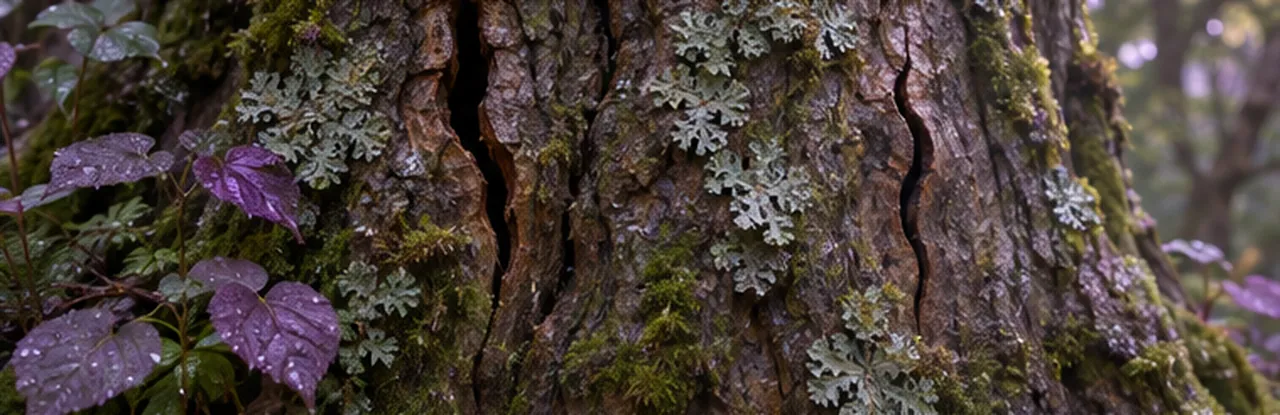
Near the living arch two natural cracks follow different directions over the bark. One lies below a branch that moves when the first sound begins. The other turns across the grain beside a quieter part of the gate. In the older sketch the two shapes looked like decorative marks all along the trunk. We wanted one of them to become a place to remember a brief sound after the leaf fringe stopped.
Give the lower mark a recognizable end
The shorter crack turns around a dark knot. Its far end approaches a pale patch of the bark, which remains visible from close and farther pictures. Follow it upward until it meets a rough place where the trunk changes angle. That turn lets the player recognize the lower mark without expecting the whole group of cracks to have the same role in the gate.
Preserve a quiet place beside the moving branch
When the light reaches the branch, some of the brighter color falls over the shorter crack. The darker end remains visible if the rest dissolves into the bark. We moved one leaf so it would hide the brighter end first rather than cover the complete mark at once. The player can glance back from a neighboring position and find the same knot before working out where the later part of the phrase belongs.
Let the first sound finish before looking away
Gate That Speaks in Leaves describes a short space after the first tone. As the leaf fringe stops, the lower crack becomes easier to read. Looking at it during the pause gives the player a relation between sound and place that can be checked from the next view. The note remains available if a second attempt begins with a quieter sound near the trunk.
Move to a side where the upper mark looks different
The longer crack becomes narrower when seen from beside the root. It is still visible once you can place the rough end of the lower mark. This connection gives a reason to compare a second position before deciding what part of a phrase has changed. Listening Left and Right uses a wider route around a root to make a similar check. Here the two viewpoints stay closer to each other and follow the changing light on the same surface.
Use the marks as memory without inventing a written language
The prototype asks people to associate the natural shapes with short sounds. They are not presented as real characters. Some players trace the bend with a finger on the screen and others locate it from the patch of lighter bark. Both can find the earlier place after the sound fades. A helpful clue should be identifiable by a little of its outline even when the main bright shape has already moved.
Reopen the cue from a later place
A Hint after the Gate Opens compares the older clue with a location where the opening has already changed. From there the bark mark remains one part of a larger setting. Place it next to a lower dark root and look for how the path opens beyond it. That later connection can preserve the location after the stronger cue to the phrase has gone quiet.
Keep the mark in the layer beneath the gate
Forest Clue Paths puts this note on the route between the ground level and the arch. A different gate could use the bend in the bark but relate it to a sound that begins farther away. Before doing that, test whether the old shape can be found from both heights after the quieter moment. Its value depends on how it helps connect an earlier reading to a later one.